Most founders assume SaaS MVP development is an expensive, slow process. They get quoted $20,000 to $80,000 by an agency, sit through three weeks of discovery calls, and then wait six months for something that barely works.
We disagree with this model fundamentally.
This is a complete, technical breakdown of exactly how we shipped a production-grade, fully deployed SaaS product in 21 calendar days for under $500 in total infrastructure costs.
This is not theory. This is a repeatable process.
The Problem With Traditional SaaS MVP Cost Estimates
When you ask a traditional app development agency "how much does it cost to build a SaaS MVP?", they are calculating a number that has almost nothing to do with what your product actually requires.
Their estimate includes:
- 2 to 4 weeks of "discovery" meetings (billable hours)
- A Project Manager translating between you and the engineer (billable hours)
- An oversized engineering team where three junior developers split work that one senior could own entirely (3x billable hours)
- Padding for unknowns — agencies routinely inflate estimates by 30% to 40% as a buffer
The actual software development cost for the core product? Often less than 25% of the final invoice.
Our Stack for Sub-$500 SaaS MVP Development
The single biggest unlock for affordable SaaS MVP development in 2026 is the modern cloud-native tooling ecosystem. Here is the exact stack we use:
| Layer | Tool | Monthly Cost at MVP Scale |
|---|---|---|
| Framework + API | Next.js 15 (App Router) | $0 |
| Database | Supabase (PostgreSQL) | $0 (free tier) |
| Auth | Supabase Auth | $0 (included) |
| Payments | Stripe | $0 (% per transaction) |
| Deployment | Vercel | $0 (Hobby / Pro at scale) |
| Resend | $0 (3,000 free/month) | |
| Storage | Supabase Storage | $0 (1GB free) |
Total fixed monthly cost at MVP launch: $0.
You pay only when you grow. That's the key insight the SaaS MVP development companies charging you $50,000 don't want you to know.
The 3-Week Build Sprint Breakdown
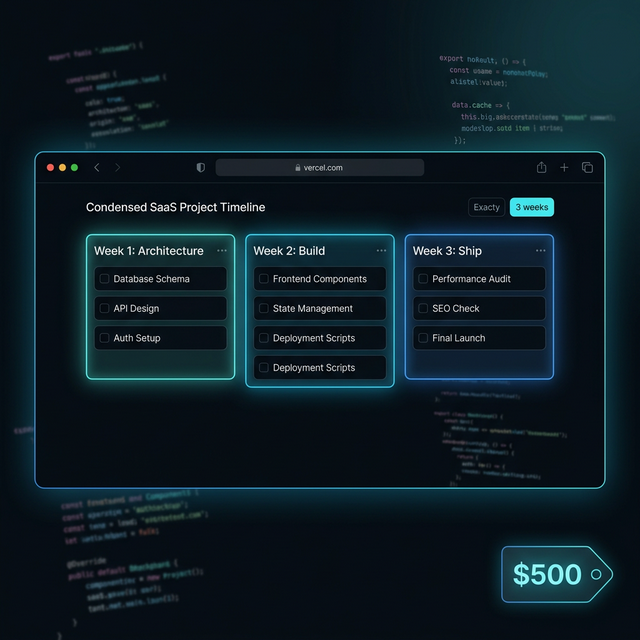
Every successful MVP we ship follows this exact three-phase structure. We will not start writing a single line of product code until Phase 1 is complete.
Week 1: Architecture & Zero-UI Sprint
Most developers want to start coding immediately. This is the single biggest mistake in MVP development.
Before writing any application code, we define:
- The Data Model — Every entity, every relationship, every constraint. Changing your database schema after launch is expensive and painful.
- The Authentication Flow — Role-based access control (RBAC), session management, and token strategy. Security is not an afterthought.
- The API Contracts — Every endpoint, its input shape, its output shape, and its authorization requirement. Documented before it is built.
Output of Week 1: A running Next.js shell with a live database schema, working authentication (sign-up, login, password reset), and a complete API design document. No product features. Just a secure, solid foundation.
Week 2: Core Feature Build
With a concrete architecture defined, feature development moves at extraordinary speed. There are no debates about the database schema mid-build. There are no security patches required because auth was designed correctly upfront.
In 5 days, we typically ship:
- The primary user dashboard
- The core product loop (the thing the user actually does in your SaaS)
- Stripe integration for subscriptions or one-time payments
- Email notifications via Resend
Output of Week 2: A working, billable product. It is not polished. It is functional.
Week 3: Polish, CI/CD, and Deploy
The final week is about production-readiness.
- Error monitoring (Sentry free tier)
- End-to-end test suite for the critical user path
- CI/CD pipeline on Vercel — every push to
mainauto-deploys after tests pass - Performance audit — Lighthouse score target above 90
- Security review — OWASP top-10 checklist against every form input and API endpoint
Output of Week 3: A live URL, a working Stripe checkout, and a CI/CD pipeline that means no developer is required for future deployments.
What This Approach Is Not
We want to be direct about the limitations of a 3-week MVP:
- This is not a 100-feature enterprise platform. An MVP has one job: validate that people will pay for your core idea.
- This is not for ambiguous ideas. We define everything in Week 1. If you cannot describe your user's core workflow in one paragraph, the sprint will fail.
- This is not magic. It requires a senior engineer who has built production SaaS before. Junior developers building an MVP without architecture experience will produce technical debt that costs more to unwind than rebuilding from scratch.
The Real SaaS MVP Cost Breakdown
| Item | Cost |
|---|---|
| Domain name (Namecheap) | ~$12/year |
| Vercel Pro (optional at MVP) | $0 to $20/month |
| Supabase (Pro if >500 users) | $0 to $25/month |
| Resend email | $0 |
| Sentry error tracking | $0 |
| Total Year 1 (pre-traction) | ~$12 to $500 |
The SaaS MVP development cost is a hosting and tooling cost. It is not a six-figure agency invoice.
Why This Matters for Your Business
Every week you are not in front of paying users is a week of lost signal.
The founders who win are not the ones who built the most features before launch. They are the ones who got real user feedback the fastest, iterated rapidly, and built only what their paying customers actually needed.
A 3-week, under-$500 SaaS MVP is not a compromise. It is the strategically correct move.
Ready to turn your SaaS idea into a live product in three weeks? Talk to our engineering team
Frequently Asked Questions
How much does it actually cost to build a SaaS MVP?
A no-fluff SaaS MVP built by a lean engineering studio can be shipped for $500 to $5,000 in infrastructure and tooling costs. The expensive part is not the software stack — modern cloud infrastructure (Vercel, Supabase, PlanetScale) costs pennies at MVP scale. The cost spike only happens when you hire a traditional agency that bills you for their overhead, not just your product.
How long does it take to build a SaaS MVP?
With a well-defined scope and a senior-only engineering pod, a focused SaaS MVP can realistically be designed, built, and deployed in 2 to 4 weeks. The key variable is how clearly the product is defined before code is written. We run a mandatory discovery and architecture sprint before any development begins.
What tech stack is best for an affordable SaaS MVP?
For affordable SaaS MVP development in 2026, the winning stack is: Next.js for the full-stack framework, Supabase for the database and authentication, Vercel for deployment and edge functions, and Stripe for payments. This combination offers near-zero infrastructure cost at MVP scale, built-in security, and massive scalability headroom.
Should I build my SaaS MVP myself or hire a developer?
If you are a non-technical founder, hiring a senior engineer or a lean engineering studio is the correct move. The risks of a poorly architected MVP — insecure authentication, non-scalable database design, no CI/CD pipeline — will cost you ten times more to fix post-launch than getting it right at the start.
Deploy Production Systems Now
Stop struggling with fragmented, underperforming technology. Let's engineer a scalable, compliant, zero-friction architecture for your business.